
Affordable AI Certification With a Verifiable Certificate
By Anu Verma
Check whether an affordable AI certificate is genuinely verifiable, what evidence to request, and which costs can appear after enrollment.
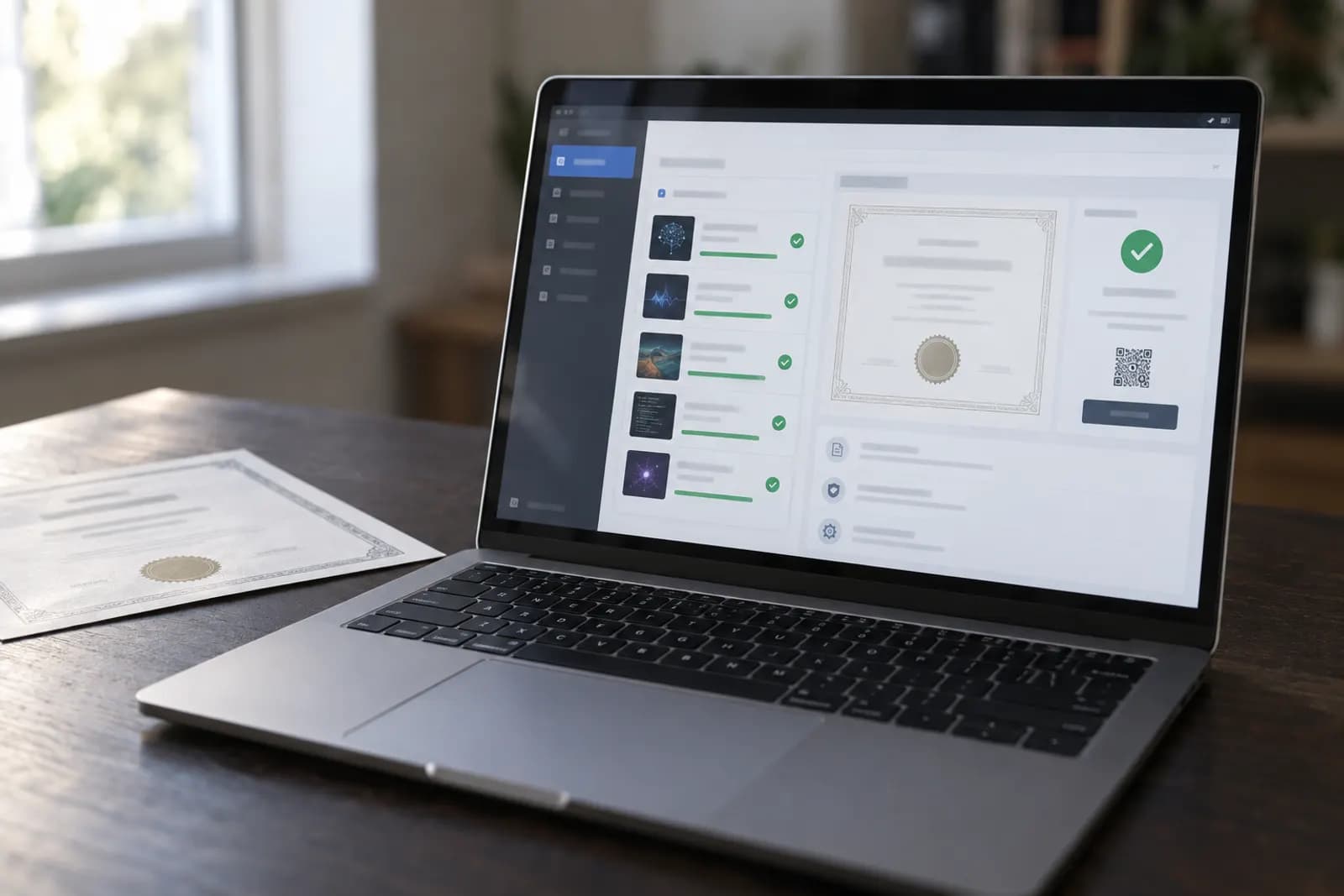
The safest affordable AI certificate is one an employer can verify through the issuer, with your name, credential details, issue date, and a working lookup link.
What makes a certificate genuinely verifiable
A genuinely verifiable AI certificate can be checked through an issuer-controlled page, not just opened as a PDF. The page should connect your name to the credential, identify the course or assessment, show when it was issued, and display a stable credential ID or verification link.
Treat a downloadable certificate as supporting evidence, not proof by itself. PDFs can be edited, copied, or issued without any meaningful assessment. A QR code also proves little if it leads to a generic homepage, an expired page, or a login wall that only the learner can access.
Before paying, open the issuer's sample credential or verification instructions in a private browser window. Check whether an independent person could confirm the record without asking you for your account password. Look for the issuer's legal or organisational name, the credential title, the recipient's name, and any statement about assessment or completion.
The practical test is simple: send the verification link to someone who does not know you and ask what they can confirm. If the answer is only that a PDF exists, the certificate is not yet verifiable enough for a hiring manager, client, or professional profile, and employers recognise AI certifications unevenly even when they are.
Should you choose a course certificate or an assessed credential?
Choose an assessed credential when you need to prove capability, and choose a course certificate when you mainly need evidence that you completed structured learning. The two labels are often used interchangeably, but they do not carry the same evidence.
A course certificate normally confirms attendance, video completion, quizzes, or module completion. That can be useful for personal development, but it does not necessarily show that you can use an AI assistant safely at work. An assessed credential should explain what was tested, how work was submitted, and whether the result came from a timed test, practical task, review, or another defined method.
Read the assessment language before comparing prices. “Certificate after completion” is weaker than a clear description of an evaluated task. For a non-technical buyer, a practical assessment might ask you to create a prompt, check an AI-generated answer against source material, or build a simple workflow in a named tool.
Your default should be the cheapest credential with transparent assessment and independent verification; AI certifications under $100 are weighed on the same points. Do not pay extra for an impressive title if the issuer cannot explain what you had to demonstrate. A plain completion certificate may be the honest choice when no skills assessment is included.
Verify a certificate before buying
Verify the issuer's process before buying by finding a public sample record, checking the lookup method, and confirming what the record will show about you. These checks prevent the common mistake of discovering after payment that verification is private or unavailable.
Start on the provider's certificate, credential, or help page rather than its sales page. Search for terms such as “verify certificate,” “credential lookup,” or “digital badge.” A credible process explains whether the record uses a unique link, credential ID, QR code, or issuer search. It should also explain what happens if the certificate is revoked, corrected, or replaced.
Next, test the sample link. Confirm that it loads without your account, identifies the issuing organisation, and distinguishes the learner's record from a generic course page. Check whether the recipient's full name is visible or whether privacy settings can hide it. Ask support a direct question if the sample is missing: “Can a third party verify my name, credential title, issue date, and assessment without logging in?”
Save screenshots of the advertised verification method and terms before checkout. Providers can change pricing, access rules, and credential policies, so the page you saw at purchase may matter later.
Compare the total cost
Compare the total cost of earning and maintaining the credential, not only the advertised enrollment price. An affordable certificate can become expensive when an assessment fee, subscription, retake, renewal, or verification charge appears later.
Write down whether the price includes the lessons, final assessment, certificate issue, digital badge, retake, and continued access to the verification record. Check whether the provider charges monthly or annually, whether cancellation stops future billing, and whether a low introductory price changes after the first period. Rules and prices change, so confirm the current terms directly with the provider before paying.
Also price your time. A short, relevant assessment can be better value than a long course that repeats basic explanations. For your use case, the right certificate should help you perform a job such as drafting customer replies, summarising documents, creating a research checklist, or connecting tools without code. A credential that teaches unrelated theory may be cheap but still wasteful.
Set a hard buying rule: do not proceed until you can state the complete payment path in one sentence. If you cannot tell whether verification remains available after cancellation, treat that uncertainty as a cost and ask the issuer first.
The evidence the certificate record should include
A useful certificate record should show your name, the exact credential title, the issuing organisation, the issue date, and a unique verification method. Those details let another person identify what you earned and distinguish it from an unverified claim on a résumé.
The record should also state whether the credential represents course completion, a passed exam, or a practical assessment. If the issuer publishes learning outcomes, the record or linked page should make those outcomes easy to inspect. A credential that says only “AI certified” gives the reader no reliable way to understand your level or the work involved.
Check whether the record can be downloaded or shared without exposing private information. A public page should not reveal your email address, payment details, or unrelated profile data. Look for a stable link that remains usable when you change jobs or remove the course from a learning dashboard.
A certificate may be verifiable and still be weak evidence. Verification proves that the issuer created the record. It does not prove that the course is recognised by every employer, that the assessment was rigorous, or that you can apply the skill. Use the record as one item in an evidence bundle, alongside a small work sample that shows how you use AI responsibly.
Spot a certificate that only looks official
Spot a weak certificate by separating official appearance from independently checkable evidence. Logos, seals, signatures, QR codes, and formal wording can be copied, while a working issuer-controlled record is harder to fake.
Check the domain behind the verification link. The page should belong to the named issuer or to a credential platform that the issuer clearly identifies. A shortened link that redirects through several unrelated domains deserves extra scrutiny. Search the issuer's support documentation for the meaning of the credential, assessment conditions, and record retention.
Watch for claims that sound broader than the evidence. “Certified AI expert” may describe a marketing title rather than a regulated qualification. “Industry recognised” is not useful unless the provider identifies who recognises it and under what standard. “Lifetime access” may refer only to course videos, not to certificate verification.
Ask for the cancellation and correction policy as well. A legitimate issuer should have a way to fix a misspelled name and explain what happens when a credential is withdrawn. If support avoids direct answers, the certificate is a poor choice regardless of price. Your default should be a modest, specific title backed by a transparent record, not a grand title backed by graphics.
A certificate that fits a non-technical job this week
Choose an AI certificate tied to a job you can perform this week, such as drafting, summarising, research support, customer-service preparation, or no-code automation. A narrow, practical credential is more useful than a broad introduction if you need an immediate work result.
Look for lessons that use tools you already have or can access legally, such as ChatGPT, Claude, Microsoft Copilot, Google Workspace, Zapier, Make, or n8n. The course should show the complete task, including how to provide context, inspect the output, correct errors, and protect confidential information. Tool availability and features change, so check the provider's current syllabus and each tool's official documentation.
Reject a course that demonstrates impressive prompts but skips verification. A useful assessment might require you to compare an AI summary with the source document, identify unsupported claims, or design a human approval step before a message is sent. Those are the failure points that matter in office work.
Use a simple decision rule. If you cannot name the job outcome, the tool used, the assessment evidence, and the verification method, do not buy yet. An affordable certificate should support a specific result, not become another unfinished course in your account.
What to do after earning the certificate
After earning the certificate, create one small, inspectable work sample and attach it to the verification record or your professional profile where appropriate. The sample turns a credential from a claim of learning into evidence that you can use the skill.
Choose a low-risk task. You could show a before-and-after customer email, a meeting-summary workflow, a research comparison table, or a no-code automation that routes a form submission for human review. Remove personal, client, and confidential information. Keep the original source, your prompt or instructions, the AI output, and your corrections so another person can see your process.
State the limits honestly. Say which tool you used, what you checked yourself, and where human approval remains necessary. Do not imply that a certificate makes AI output accurate or that it qualifies you for regulated advice. OpenAI, Anthropic, Google, Microsoft, and automation platforms update their features and policies, so revisit the workflow when a tool changes.
Store the certificate link in two places and test it later without signing in. If the link breaks, contact the issuer while your account details are available. Verification is not a one-time purchase feature. It is a record that needs to remain accessible when someone actually asks to check it.
Sources consulted
- OpenAI Help Center (help.openai.com)
- Anthropic Documentation (docs.anthropic.com)
- Microsoft Support (support.microsoft.com)
- n8n Documentation (docs.n8n.io)
Frequently asked questions
Is an online AI certificate worth paying for?
An online AI certificate is worth paying for when it has a clear assessment, an issuer-controlled verification record, and direct relevance to work you need to do. A cheap completion PDF may be enough for personal learning, but it is weak professional evidence. Compare the full cost, assessment method, verification access, and practical output before enrolling.
Can an employer verify an AI certificate without my login?
An employer can verify an AI certificate without your login only if the issuer provides a public credential page, lookup tool, or shareable verification link. Test the method in a private browser before buying. If verification requires your account, a private dashboard, or a forwarded PDF, ask the issuer whether an independent check is available.
Is a QR code enough to prove a certificate is real?
A QR code is not enough by itself. It is useful only when it opens an issuer-controlled record that identifies the recipient, credential, issue date, and verification status. Scan it before paying and confirm that it does not lead to a generic homepage, an expired page, or a document that can be edited.
Do AI certificates expire or require renewal?
Some AI certificates expire, require renewal, or depend on an active subscription, while others remain issued without a renewal date. Providers can change these rules, so check the current credential terms and verification policy before enrolling. Ask whether the public record remains available after cancellation and whether updated tools require a new assessment.
What is the best affordable AI certification for a beginner?
The best affordable AI certification for a beginner is the lowest-cost option that assesses a job-relevant task and provides independent verification. Choose a course using tools you can access now, such as ChatGPT, Claude, Copilot, Google Workspace, Zapier, Make, or n8n. Avoid broad titles that do not explain the tested skill or evidence.
For you
Learn to do this with AI, free
Short courses for people who aren't engineers: ChatGPT, Claude, prompting and automation. Every lesson is free, with no card.
Start a free courseFor companies
Make an AI or automation tool?
List it in the directory for $9.99, refunded in full if it isn't approved, or claim its page if it is already here.
Related guides
 How to Get an AI Certification Online That HelpsStart by matching an AI certification to a real job task, then compare assessment quality, verification, renewal rules and portfolio evidence.
 Free ChatGPT Course With a Certificate: What to CheckMost free ChatGPT certificates charge at the certificate step. Check who issues it, whether it is assessed and what an employer can verify first.
 AI Essentials and Certification for Non-EngineersAI essentials training and certification for non-engineers: check the skills, tools, assessment tasks, and certificate evidence before you pay.
Drafted with AI assistance from our own research and Search Console data, and reviewed by the Automate Basics team before publishing. Tools and prices change; check the linked official source before you act.
Get the next one by email
One email a week: what changed in AI for people who use it at work, and what to do about it.