
Free ChatGPT Course With a Certificate: What to Check
By Anu Verma
A free ChatGPT course may include a certificate, but you should check the issuer, assessment, access terms and whether the credential proves useful skills.
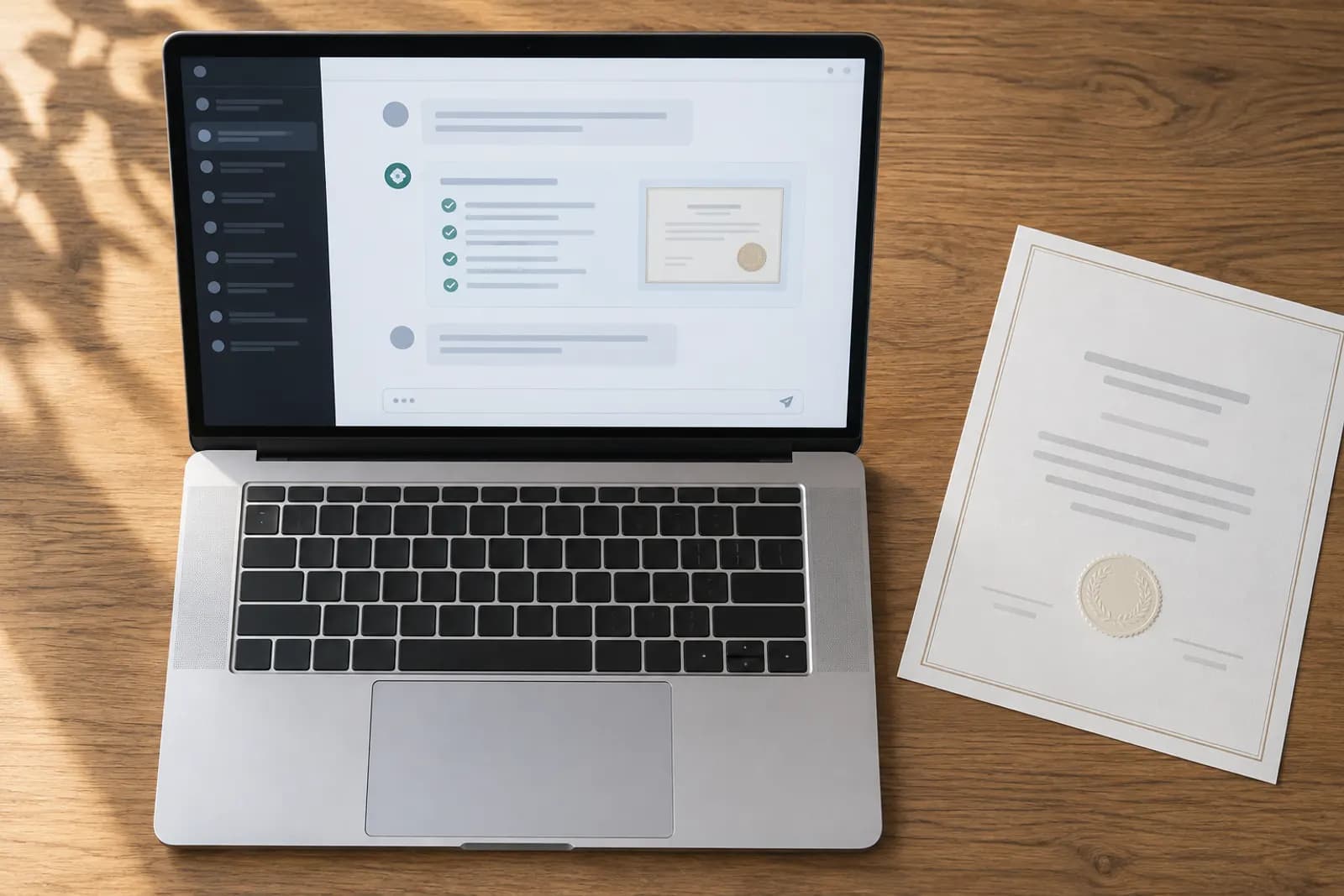
A free ChatGPT course can include a certificate, but the useful choice is the one that teaches a job you can perform, assesses your work, and clearly states who issues the credential.
Is there a genuinely free ChatGPT course with a certificate?
A genuinely free ChatGPT course with a certificate should let you access the lessons and earn the credential without entering a payment step later. In practice, many offers use free to describe the lessons only. The certificate, graded assessment, downloadable file, or identity verification may cost extra.
There is no single universal certificate that proves you are officially certified in ChatGPT. A provider might issue a course-completion certificate, an assessment certificate, or a badge from its own learning platform. Those credentials are not interchangeable. A completion certificate usually shows that you finished content. An assessment certificate gives stronger evidence that you passed a test or submitted work.
Before enrolling, open the certificate or pricing page rather than relying on the course title. Check whether the provider names the issuer, says what you completed, and states whether the certificate is included at no charge. Also check whether access to ChatGPT itself is free, limited, or subject to current account and plan rules. OpenAI's help documentation is the appropriate place to check current ChatGPT plan details, because those rules can change.
What a ChatGPT certificate should prove
A useful ChatGPT certificate should prove a specific capability, not just that you watched lessons. For a non-technical learner, that capability might be turning a rough request into a reliable prompt, checking an answer against source material, or building a repeatable workflow for meeting notes.
Read the learning outcomes for verbs such as create, revise, evaluate, compare, or apply, the same test used to compare AI training courses for real work. Vague promises about mastering AI tell you less than a practical assessment. A stronger course asks you to produce something, such as a customer-response draft, a spreadsheet formula explanation, or a project brief, then applies a stated rubric.
Treat a certificate that only records attendance as a participation record. It can still help you document learning, but it should not be presented as proof that you can safely use ChatGPT at work. The best evidence is a small work sample alongside the certificate. Keep the original prompt, the model response, your fact checks, and the final version. That record shows judgment, which a certificate image cannot show by itself.
Verify whether the certificate is free
Verify the certificate cost at the point of issuance, not just on the course landing page. Look for a plain statement covering lessons, quizzes, assessment, certificate download, and any identity check. If the page says free enrollment but displays a locked certificate or asks for payment after completion, the course is not a free certificate course in the sense most buyers intend.
Check whether free access expires, whether the provider requires a trial, and whether canceling that trial affects your certificate. Read the refund and renewal terms before entering payment details. A course can be free to start while still requiring a paid subscription to finish.
Save the course page, certificate terms, and issuer name when you enroll. Providers change access rules, assessment requirements, and branding. The final credential should show the learner name, course title, issuing organization, completion or assessment date, and a verification link if one exists. Do not treat a decorative PDF as independently verifiable. If an employer or client matters, ask what evidence they accept before choosing the course.
The course format that suits your job
Choose a task-based ChatGPT course if you need useful output this week, and choose a theory-heavy course only if you need formal background. A solo founder may need a repeatable process for turning customer interviews into a product brief. An office worker may need to summarize documents without losing decisions or owners. A freelancer may need a proposal workflow that keeps claims and prices under human control.
A short, exercise-led course is usually the better default for these jobs. Look for lessons that show the input, prompt, model output, revision, and final check. Tool demonstrations should name the current interface and explain what to do when the model produces a confident mistake. Courses focused only on prompt tricks age quickly because ChatGPT features, limits, and menus change.
Pick a longer course when you need governance, privacy, or team adoption guidance, and see whether your team can get free AI training and certificates before paying per person. You need to understand which information must not be pasted into a chat, how to retain source documents, and who approves generated work. A certificate cannot compensate for a course that never addresses those decisions.
Test a course before spending your week on it
Test a prospective course with one real, low-risk task before committing to the full curriculum. Choose work you already understand, such as rewriting a customer email, extracting action items from meeting notes, or creating a first draft of a frequently used checklist.
Preview the lesson that handles the task. The lesson should show a usable prompt, explain the information ChatGPT needs, and include a review step. A weak lesson says to ask ChatGPT for a better answer. A useful lesson tells you how to define the audience, provide constraints, request a format, inspect unsupported claims, and revise the result.
Run the exercise with information that does not expose private customer, employee, financial, or confidential business data. Compare the course method with your current process. If the method adds more checking and rewriting than it saves, the course is teaching a demonstration rather than a workflow. Keep a simple before-and-after record. The time saved, errors caught, and steps you can repeat matter more than how polished the course certificate looks.
The safest first ChatGPT project for a beginner
A controlled drafting project is the safest first ChatGPT project because you can check every important fact before anyone sees the result. Ask ChatGPT to turn your own notes into a structured draft, not to invent research or make a decision on your behalf.
Start with a clear role and output format. For example, ask for a customer-support reply with a subject line, a short explanation, and a next step. Include the facts the reply may use, and instruct ChatGPT to mark missing information as a question instead of guessing. Review every date, price, policy statement, name, and promise against the source notes.
Then ask ChatGPT to critique the draft against a checklist. Use a separate pass to identify unsupported claims, unclear wording, and anything that sounds more certain than the evidence allows. This workflow works in ChatGPT and can be adapted to Claude or another assistant, but the interface and available features vary. A course earns its place when it teaches this complete loop, from source material to checked final output, rather than stopping at prompt writing.
When a certificate is worth more than a work sample
A certificate is most useful when a hiring process, client, manager, or internal learning record explicitly asks for one. A work sample is usually stronger when someone wants to know whether you can use ChatGPT responsibly on a real task.
Use the certificate to make your learning easy to document. Use the work sample to make your ability easy to judge. A good portfolio item can show the original task, the information supplied to ChatGPT, the instructions used, the checks performed, and the final human-edited result. Remove confidential information and label generated material honestly.
The trade-off is time. A certificate may take less effort to share, while a credible work sample takes longer to create and explain. Do not pay for a credential simply because the course page uses words such as professional, accredited, or industry-recognized. Ask who recognizes it and for what decision. If the answer is only the issuing platform, treat it as evidence of completion, not as a qualification that transfers automatically between employers.
Choose between two free certificate courses
Choose the course that gives you the clearest assessed task, certificate terms, and review process, even if the other course has a more impressive title. Use a simple decision rule: prefer evidence over branding, transparent cost over a free-looking enrollment button, and a workflow over a collection of prompt examples.
Compare the courses on five questions. Does the syllabus match a job you need to perform? Is the certificate included without a trial or upgrade? Does the provider explain how work is assessed? Does the course teach fact checking, privacy, and human approval? Can you verify the issuer and completion record afterward?
Reject a course when it promises that ChatGPT will produce accurate results automatically, hides the certificate price, or teaches you to paste sensitive information into a public tool. Also reject courses that use old screenshots without explaining that ChatGPT features and rules change. The best free option may be the one with fewer lessons but a complete exercise, a clear rubric, and instructions you can repeat when the interface changes.
Sources consulted
- OpenAI Help Center (help.openai.com)
Frequently asked questions
Can I get a ChatGPT certificate for free?
Sometimes. Some providers include a course-completion certificate at no charge, while others make lessons free but charge for assessment, identity verification, or certificate access. Check the provider's certificate and pricing terms before enrolling. There is no universal official ChatGPT certificate, so identify exactly who issues the credential and what it records.
Does a free ChatGPT certificate help with a job?
A free certificate can document that you completed training, but it rarely proves practical ability by itself. Pair it with a short work sample showing your prompt, source material, fact checks, and final human-edited result. Ask the employer or client what credentials they recognize before choosing a course.
How can I tell if a ChatGPT course certificate is legitimate?
Check whether the issuer is named, the completion requirements are clear, and the certificate can be verified through the provider. Look for an assessment or submitted project rather than attendance alone. Confirm the total cost, access period, and identity requirements, because course and certificate terms can change.
What should a beginner learn in a ChatGPT course?
A beginner should learn how to provide useful context, specify an output format, ask for missing information instead of guesses, and check every important claim against source material. The course should also cover privacy and human approval. Prompt tricks matter less than a repeatable workflow for one real job.
Is a ChatGPT certificate the same as an AI qualification?
No. A ChatGPT course certificate usually records completion or performance in one provider's course. An AI qualification may involve broader knowledge, formal assessment, or recognition by a specific institution. Read the credential's wording carefully, and do not describe a completion certificate as an accredited qualification unless the issuer explicitly supports that claim.
For you
Learn to do this with AI, free
Short courses for people who aren't engineers: ChatGPT, Claude, prompting and automation. Every lesson is free, with no card.
Start a free courseFor companies
Make an AI or automation tool?
List it in the directory for $9.99, refunded in full if it isn't approved, or claim its page if it is already here.
Related guides
 Affordable AI Certification With a Verifiable CertificateCheck whether an affordable AI certificate is genuinely verifiable, what evidence to request, and which costs can appear after enrollment.
 How to Get an AI Certification Online That HelpsStart by matching an AI certification to a real job task, then compare assessment quality, verification, renewal rules and portfolio evidence.
 AI Certification Under $100: What’s Worth Buying?Find an AI certification under $100 that proves useful work, avoid completion-certificate traps, and choose a credential for your actual job.
Tools in this piece
Drafted with AI assistance from our own research and Search Console data, and reviewed by the Automate Basics team before publishing. Tools and prices change; check the linked official source before you act.
Get the next one by email
One email a week: what changed in AI for people who use it at work, and what to do about it.