Guides
1 / 10
Start herebeginner

Are AI Certifications Recognised by Employers? Compare Options

By

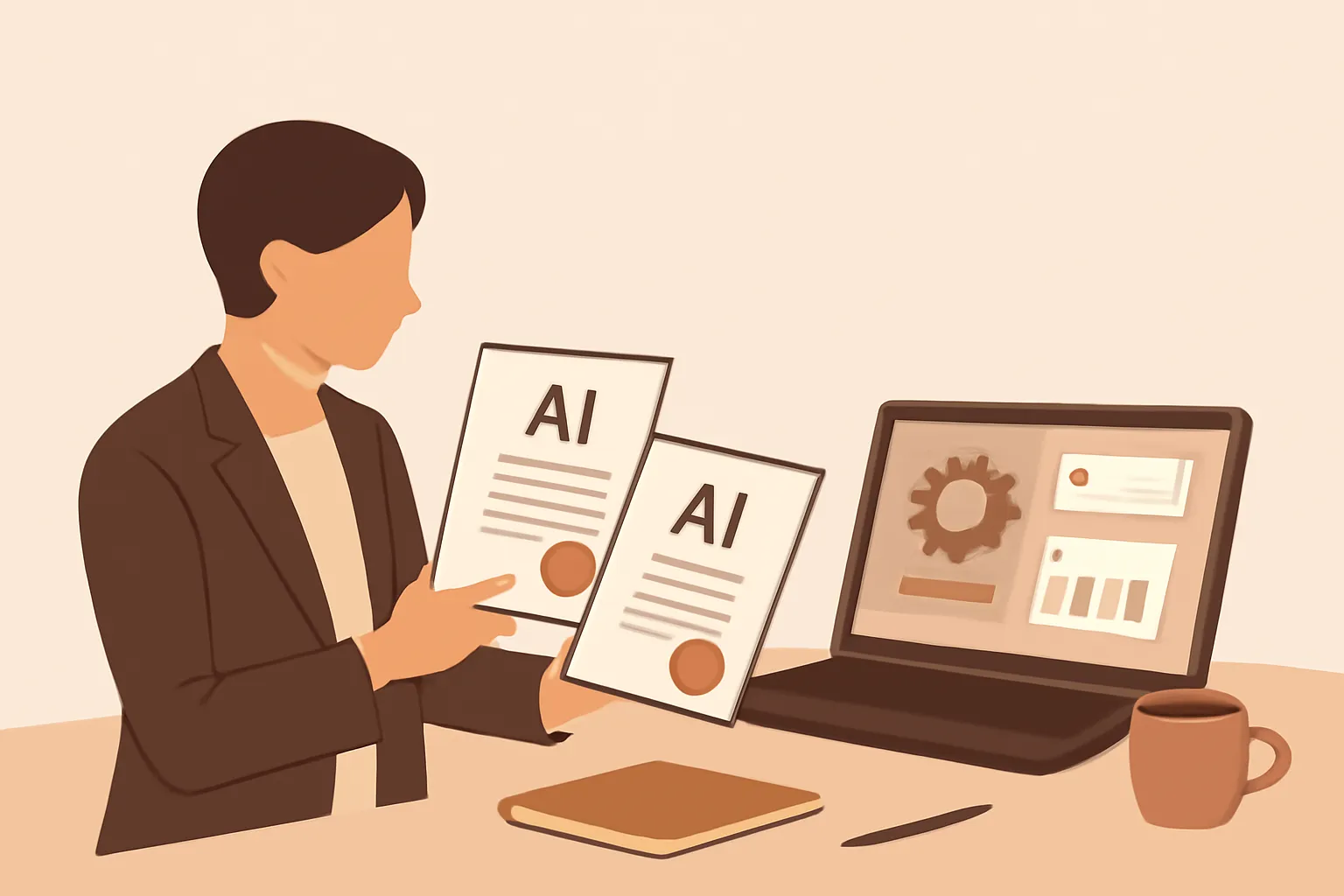
Professional comparing AI certificates beside a laptop showing a practical workflow example

AI certifications are recognised by employers unevenly. After a pass, an optional certificate costs $49, $99, $129 or $149, depending on the course.

AI certifications can help employers understand your learning, but recognition depends on the issuer, assessment, relevance and evidence of work. For a non-technical role, a small proof of a real result usually carries more decision value than a certificate alone.

Swipe up to begin
Concept

Are AI certifications recognised by employers?

AI certifications are recognised by employers unevenly, because the certificate alone does not show what you can do in a particular job. Recognition depends on four checks: who issued it, whether your knowledge was assessed, whether it matches the role, and whether you can show a useful result.

A certificate from a known technology vendor can signal familiarity with that vendor's platform. A qualification from an accredited education provider can carry formal weight in organisations that use qualification frameworks. A course certificate from an independent training company can show structured learning, but an employer may still ask how you applied it.

The common mistake is treating recognition as a yes-or-no property. Employers don't recognise an abstract certificate; they decide whether a specific credential reduces uncertainty about a specific candidate. A ChatGPT course may be relevant to a customer-support role, while an AI automation certificate may be more relevant to someone setting up workflows in Zapier or Make. Neither proves that you can safely handle confidential data, check AI output or maintain a workflow.

Use the certificate as a supporting signal. Pair it with one short case study showing the task, tool, human checks and measurable result.

For more context, read How to Compare AI Training Courses for Real Work.

Concept

Which AI credential type suits your situation?

The best AI credential type depends on what an employer needs to trust: platform familiarity, formal education, practical ability or simply evidence that you started learning.

Vendor certification suits you when a job explicitly uses a platform such as Microsoft Copilot, Google tools or another named system. Its advantage is relevance to a recognisable product. An accredited qualification suits you when an employer asks for formal study, a regulated pathway or a qualification that can be compared within an education framework. Check the exact accreditation rather than assuming every certificate has it.

An assessed independent certification suits you when you want proof that you passed a defined test without committing to a long programme. Its value comes from transparent topics, assessment conditions and verification. A course completion certificate suits you when you need guided learning, but it carries less evidence if there is no assessment.

No certificate can be the right choice when you need a result quickly and the hiring decision will focus on work samples. For a non-technical worker, the default is an assessed, relevant credential plus one small demonstration. Choose a formal qualification instead when the job description or employer specifically requires one.

For more context, read What AI Visibility Trends Can You Automate in Reports?.

Concept

What will an employer verify before trusting the certificate?

An employer can verify an AI certificate by checking the issuer, assessment, identity, date, credential scope and verification method. A polished badge without those details is weak evidence.

Start with the issuer's name and purpose. Is it a software vendor, university, professional body or training company? Then check whether you passed an exam, submitted assessed work, or merely completed lessons. The distinction matters because course attendance and demonstrated competence answer different questions.

Look for a public verification page or a credential ID that resolves to the holder, title and issue details. Check whether the certificate covers one tool, general AI use, automation, governance or another specific area. An employer should also be able to tell whether the credential is current, especially where software features and workplace rules change.

You can make review easier by placing the verification link beside the certificate on your CV or profile, then adding one sentence about the practical task you completed. Don't claim that a certificate is accredited, vendor-issued or externally recognised unless the issuer says so. Verifiable means the record can be checked. It does not automatically mean the credential has formal national recognition or proves job performance.

Concept

When is a vendor certification the stronger choice?

A vendor certification is the stronger choice when the role names the vendor's tool and your work will begin inside that tool. The credential then answers a narrow, useful question: have you learned the platform's basic capabilities and terminology?

For example, a role built around Microsoft Copilot may make a Microsoft credential more relevant than a general AI certificate. A team using ChatGPT, Claude or Gemini may value evidence that you can work carefully with that tool, but the tool name should still appear in your work sample. Employers may change products, so don't present platform knowledge as general AI expertise.

Vendor credentials have a trade-off. They can become less useful when a product changes, and they may say little about workflow design, judgment, privacy or communication. A person who can produce a good prompt but cannot review the answer or fit the tool into a process still has a practical gap.

Choose vendor certification when the job advert, manager or client has named the platform. Add a vendor-neutral example showing how you checked outputs, protected sensitive information and handed the result to a human. That combination makes the credential relevant without pretending it covers every AI system.

Concept

Should you choose an independent assessed certification?

An independent assessed certification suits you when you need a structured way to show practical AI knowledge but the employer has not specified a vendor. The assessment can give your learning a clearer boundary than watching lessons alone.

Check the syllabus before enrolling. For a non-technical role, useful coverage may include prompting, output review, privacy, delegation, workflow design and limits of automation. An exam that tests terminology but not decisions may be less useful for the job you want. Also check whether the exam is supervised, whether retakes are available, how the result is verified and who issues the certificate.

The important trade-off is credibility versus fit. An independent issuer may be unfamiliar to a hiring manager, even when the assessment is serious. You can close that gap by explaining what was tested and attaching a short work sample. Write the credential title exactly, link to verification, and avoid describing it as accredited unless that is documented.

Choose this route when you want an assessed signal and can explain its scope in plain language. Don't buy it merely to add a logo to your CV. If you cannot connect the assessment to a task the employer needs, a focused example may be the better next move.

Concept

When is a course certificate not worth choosing?

A course certificate is not worth choosing when it only confirms that you opened lessons and the employer needs evidence of independent performance. Completion can show interest, but it cannot by itself answer whether you can make a safe, useful decision with AI.

A course certificate can still be sensible when you need a guided introduction, want to learn a named tool, or need a low-friction way to organise practice. Before choosing one, ask whether the course includes an exam or assessed task, names the tools covered, explains the certificate's verification, and teaches checks for inaccurate or sensitive outputs.

The failure mode is collecting several completion certificates while avoiding the task you want AI to perform. A freelancer may finish courses on ChatGPT and Claude but still lack a repeatable process for turning client notes into a reviewed draft. A small-business owner may learn about automation but never document what happens when a trigger fails.

If you choose a course without an exam, create your own evidence. Save the original task, prompt or instructions, output, review changes and final result. A one-page case study can explain more about your judgment than a completion badge. Treat the certificate as a learning record, not a substitute for proof.

Concept

How can you prove AI ability without writing code?

You can prove non-technical AI ability with one repeatable before-and-after workflow that names the tool, human checks and business result. Code is not required, but a vague claim such as “I use AI at work” is hard to evaluate.

Choose a task you already understand, such as drafting replies, summarising meeting notes, sorting enquiries or preparing a product description. Record the starting problem and the old manual process. Then show the tool you used, the instructions you gave it, the information you supplied, and the changes you made after reviewing the output.

Include the failure mode. Explain what the tool got wrong, what rule you added, or where you kept a human approval step. If you connected tools through Zapier, Make, n8n or another no-code service, show the trigger, action and exception path in plain language. Do not include private customer information in a public sample.

Finish with a result the reader can inspect, such as a cleaner template, fewer handoffs or a repeatable process. Avoid unsupported claims about time or money saved. A hiring manager can then judge your reasoning, tool choice and safeguards instead of guessing from a certificate title. This evidence also helps you decide whether any credential adds useful context.

Concept

Where does Automate Basics fit among these options?

Automate Basics fits the independent practical-learning category, with free-to-read courses and four assessed certifications for professionals who aren't engineers. Its credentials can support a portfolio, but they are not accredited by a national qualifications body and should be presented accurately.

The site has eight short courses with no exam or certificate, covering tools including ChatGPT, Claude, Gemini and Copilot. Those courses suit someone who wants to learn a tool before deciding whether a credential matters. The first lesson needs no account, and the remaining course content needs a free account.

The four assessed options are AIE-100 AI Essentials, AIW-200 AI at Work, AID-300 AI Agents and Delegation, and AIA-300 AI Automation. The exams are free. After a pass, an optional certificate costs $49, $99, $129 or $149 respectively, or $349 for all four, with no subscription. Certificates are issued by Automate Basics and can be verified at automatebasics.com/verify.

Choose Automate Basics when you want practical, assessed evidence without a subscription and can explain its scope to an employer. Choose a vendor credential when a specific platform is required, or an accredited qualification when formal recognition is a stated requirement. In every case, attach a relevant work sample.
Questions people actually ask

Do employers prefer AI certificates from software vendors?
Employers may find a vendor certificate easier to interpret when the job uses that vendor's platform. It still doesn't prove judgment, workflow design or safe output review. Match the credential to the role, name the tool clearly, and add a work sample showing how you used it and checked the result.
Is an AI certificate without an exam worth listing?
A non-exam certificate can show that you completed structured learning, but it carries less evidence of tested knowledge. List it accurately as course completion, not certification of competence. Add a practical example, or choose an assessed credential if the employer expects proof beyond attendance.
Are Automate Basics certifications accredited?
Automate Basics certifications are issued by Automate Basics, can be verified at automatebasics.com/verify, and aren't accredited by a national qualifications body. The exams are free, while optional certificates cost according to the certification. Present them as independently assessed practical credentials, alongside relevant work evidence.
Should I get an AI certificate before applying for jobs?
Not necessarily. Apply when you can show a useful, reviewed example that matches the role. Get a certificate first if the job asks for one, you need structured learning, or the credential fills a clear knowledge gap. Don't delay an application solely to collect a badge.
How can I compare two AI certifications fairly?
Compare the issuer, syllabus, assessment method, verification, tool coverage, accreditation status and relevance to the target role. Then ask what evidence each credential adds beyond a work sample. A cheaper or better-known certificate isn't automatically stronger if it tests the wrong skills for your intended job.

Drafted with AI assistance from our own research and Search Console data, and reviewed by Rahul A before publishing. Tools and prices change; check the linked official source before you act.