Guides
1 / 10
Start herebeginner

Best AI Automation Courses for Non-Technical Work

By

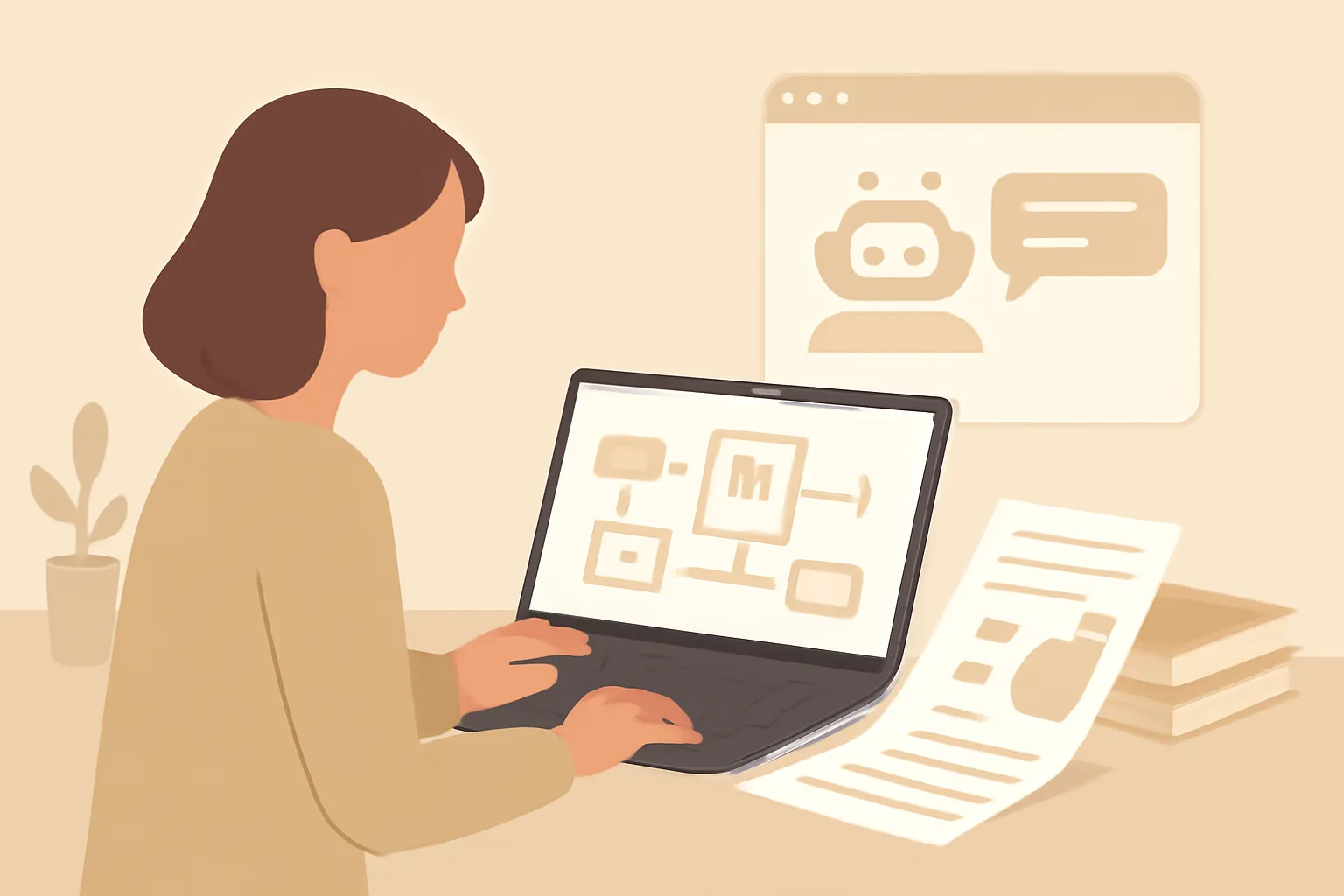
Non-technical worker testing an AI workflow across a laptop and business documents

The best AI automation course depends on your job. Compare practical courses, tool coverage, workflow practice, exams, certificates and costs.

For a non-technical learner who needs a result this week, the best AI automation course is the one that teaches your chosen tool and ends with a tested workflow, not just a completion badge.

Swipe up to begin
Concept

Which AI automation course is the best default?

Automate Basics is the best default for a non-technical person who wants to build a useful AI workflow without writing code. Its courses teach practical use of ChatGPT, Claude, Gemini and Copilot, so you can start with the tool you already use or the one your job requires. Every course is free to read, the first lesson needs no account, and the remaining lessons need a free account.

The important qualification is that a course is only useful if it gets you to a working job. Pick one small outcome before you start, such as turning meeting notes into tasks, drafting replies from a form submission, or extracting fields from an invoice. Then judge each lesson by whether it helps you complete that outcome.

Automate Basics has eight short courses without an exam or certificate, plus four assessed certifications. The certifications cover AI Essentials, AI at Work, AI Agents and Delegation, and AI Automation. The free exam and optional paid certificate are separate from the learning itself, so you don’t need to buy a certificate to use the course material.

For more context, read AI Training for Non-Engineers: A Practical First Week.

Concept

How do you choose a course for one job this week?

Choose the course by the job you want to finish, not by the word automation in its title. Write the input, decision and output in one sentence. For example, “When a customer form arrives, classify the request and draft a reply for my review.” That sentence tells you what the course must cover.

Next, identify the tools already involved. A workflow using Gmail, a spreadsheet and ChatGPT needs different instruction from one using Microsoft 365 and Copilot. A course that explains prompts but never addresses the handoff between tools won’t get you to the result.

Look for lessons that show structured inputs, reusable instructions, review points and failure handling. You should be able to copy the process into your own account, replace the sample data, and test it with an ordinary case and an awkward case. If a course only demonstrates impressive outputs from carefully prepared examples, it may teach prompting without teaching automation.

The best first project has low risk and a clear human approval step. Avoid starting with payroll, legal decisions, medical information or unsupervised customer promises. Your first win should save repetitive effort while leaving you in control of the final action.

For more context, read Can Your Team Get Free AI Training and Certificates?.

Concept

Which course is best for ChatGPT, Claude, Gemini or Copilot?

The best course is usually the one that teaches the AI tool already approved or available in your workplace. ChatGPT, Claude, Gemini and Copilot can all help with drafting, classification, extraction and summarisation, but their menus, account settings, connectors and data controls differ. A general AI lesson won’t necessarily show the steps in your chosen product.

Use a tool-specific course when the task depends on features such as file handling, reusable instructions, workspace permissions or connections to other services. Use a broader automation course when the hard part is designing the process: defining the trigger, shaping the data, checking the result and deciding when a person must approve it.

Automate Basics covers all four named tools, which makes it a practical starting point when you’re comparing them or working across different clients. Start with one tool rather than trying to master all four. Test the same small task in the tool you expect to keep using, then record where the output fails, where information is lost and where a manual check is needed.

Official product documentation is the tie-breaker for changing interface steps, account requirements and current capabilities. Course lessons explain the method; the vendor documentation confirms what your account can do today.

Concept

What should a useful AI automation course make you build?

A useful AI automation course should make you build a complete, reviewable workflow, not merely produce a polished answer in a chat window. The workflow should have a defined trigger, an input format, an AI instruction, an output destination and a human checkpoint where the risk justifies one.

For example, a practical exercise might take a support message, label its topic and urgency, draft a response, and place both the label and draft in a review queue. The exercise becomes much less useful if it skips what happens when the message is empty, contradictory or outside the known categories.

Check whether the course teaches you to constrain outputs. Asking for a fixed set of labels, a consistent table or a clearly marked “needs review” result is more useful than asking for a general opinion. Also check whether it explains how to test the workflow with examples that were not used in the demonstration.

A completion screen tells you that you reached the end of the material. A working workflow tells you whether the material transferred to your job. Prefer courses that leave you with instructions, test cases and a way to inspect the output before anything is sent, changed or deleted.

Concept

How can you turn an AI course into a working automation this week?

Turn a course into a working automation by limiting the first build to one trigger, one AI task and one safe output. Start by collecting five ordinary examples from the job you want to improve. Remove confidential information where possible, and write down what a correct result should contain.

Build the workflow manually before connecting services. Ask the model to perform the task on each example, compare the answers with your expected results, and revise the instructions when it fails. This separates a weak prompt from a broken integration. Only after the task works should you connect a form, inbox, spreadsheet or document system.

Keep the first output in a draft folder, review queue or separate spreadsheet. Don’t let a new automation send external messages, overwrite records or delete files until you’ve tested unusual inputs. Add a simple stop condition, such as “needs review” when required information is missing or the confidence of the classification is unclear.

Use the course as a sequence of decisions, not a video to finish. After each lesson, apply one idea to your own examples. If you can’t explain what starts the workflow, what the AI is allowed to change and where you inspect the result, the build isn’t ready for unattended use.

Concept

Is a free AI automation course enough for your first project?

A free course is enough for a first project when your goal is skill and a tested workflow, rather than an externally recognised qualification. Automate Basics lets you read every course for free, with the first lesson available without an account and the rest requiring a free account. That removes cost as a reason to postpone a small, low-risk experiment.

The no-cost route is especially suitable for solo founders, freelancers and office workers who need to decide whether a task is worth automating. You can learn the tool, test the process and measure whether the result saves time before paying for anything. You should still account for any separate charges from the AI or automation services you connect, because free course access doesn’t make those services free.

A paid certificate may make sense when you need a record of assessment for your own development or an employer’s process. Automate Basics offers optional certificates after a free pass, priced at $49 for AIE-100 AI Essentials, $99 for AIW-200 AI at Work, $129 for AID-300 AI Agents and Delegation, $149 for AIA-300 AI Automation, or $349 for all four. The certificates are issued by Automate Basics, verifiable at /verify, and aren’t accredited by a national qualifications body.

Concept

What can go wrong when you follow an AI automation course?

The most common failure is automating a vague decision before defining what a correct answer looks like. “Sort these emails” sounds simple until you need to decide how to handle mixed requests, missing context, spam, urgent messages or two categories that overlap. A course that skips those cases can leave you with a fragile demonstration.

Another failure is trusting fluent text. AI can produce a convincing answer while inventing a detail, using the wrong record or quietly omitting a field. Require the workflow to show its source information where practical, use structured outputs for repeated tasks, and route uncertain cases to a person. Review the raw input as well as the generated result.

Permissions create a separate risk. Connecting an AI tool to a mailbox, drive or customer system can expose more information than the task needs. Use the narrowest access available, avoid putting secrets into prompts, and check where the connected service stores data. Vendor settings and capabilities change, so confirm current guidance in the relevant official documentation.

Finally, don’t confuse a successful test with reliability. Run old examples, awkward examples and an empty example. Record the failures. If you can’t detect a bad result before it reaches a customer or changes a record, keep the workflow assisted rather than unattended.

Concept

Which learning path fits your goal: skill, workflow or certificate?

Choose the skill path if you need to understand practical AI use, the workflow path if you need to automate a specific job, and the certificate path if you need assessed evidence of learning. These goals overlap, but they aren’t interchangeable. A certificate doesn’t prove that a workflow fits your business, and a working workflow doesn’t automatically provide a qualification.

For immediate work, start with one short course and one bounded task. Move to the assessed AI Automation certification only if testing your knowledge and having a verifiable certificate matters to you. Choose AI at Work when your main need is applying AI across ordinary professional tasks, and choose AI Agents and Delegation when you’re specifically studying how to hand off multi-step work while retaining control.

The four Automate Basics certifications are AIE-100 AI Essentials, AIW-200 AI at Work, AID-300 AI Agents and Delegation, and AIA-300 AI Automation. Each exam is free, while certificates are optional and have the published prices listed in the course information. There’s no subscription, and the certificates are issued by Automate Basics rather than a national qualifications body.

The practical decision rule is simple: don’t pay before you know why you need the certificate. Build or test the workflow first. If the result is useful, you’ll know whether further study should target the tool, the process design or assessed proof of learning.

Questions people actually ask

What is the best AI automation course for a complete beginner?
Automate Basics is a practical starting point for a complete beginner who doesn’t code. Its free courses cover ChatGPT, Claude, Gemini and Copilot, and the first lesson needs no account. Start with one small job, such as drafting replies or classifying requests, then test the workflow before adding integrations or unattended actions.
Can I learn AI automation without coding?
Yes. You can learn useful AI automation through prompts, structured inputs, review steps and no-code connections between tools. Coding becomes relevant for custom logic or advanced integrations, but a first workflow can stay no-code. Choose lessons that show triggers, outputs, testing and failure handling rather than only explaining AI concepts.
Are Automate Basics certificates accredited?
Automate Basics certificates are issued by Automate Basics, are verifiable at /verify, and aren’t accredited by a national qualifications body. The exams are free, while the optional certificates have separate prices. Treat them as evidence of assessed learning, not as a nationally regulated qualification.
Should I take a course or read the official tool documentation?
Use a course to learn the workflow method, then use official documentation to confirm current features, permissions and setup steps. Product interfaces and rules change, so documentation from OpenAI, Anthropic, Google or Microsoft may be more current for a specific tool. You usually need both for a reliable build.
What should my first AI automation project be?
Choose a repetitive, low-risk task with a clear input and output, such as turning meeting notes into draft tasks or classifying incoming requests. Keep a human approval step, test ordinary and awkward examples, and avoid starting with payments, legal decisions, medical information or automatic customer promises.
Drafted with AI assistance from our own research and Search Console data, and reviewed by Rahul A before publishing. Tools and prices change; check the linked official source before you act.